
QL-4Tr1: QL-Component Triangles
A Quadrilateral has 4 defining random lines L1, L2, L3, L4 without preference or order.
With these lines 4 sets of 3 different lines can be formed:
- L1, L2, L3
- L1, L2, L4
- L1, L3, L4
- L2, L3, L4
Perspective property of the QL-Diagonal Triangle with all QL-Component Triangles
Let QL-DT be the Diagonal Triangle of the reference quadrilateral.
There are 3 Component Quadrigons because there exist 3 cyclic orderings of 4 lines.
Reorder the 3 Component Quadrigons (QG) so that they all begin with L1.
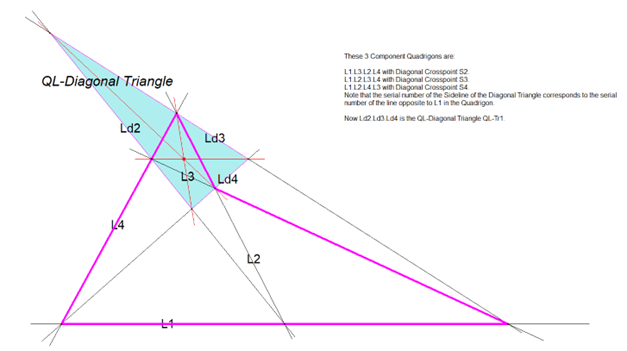
We then obtain: L1.L3.L2.L4, L1.L2.L3.L4, and L1.L2.L4.L3.Next, determine for each QG the intersection point (QG-P1) of the opposite QG‑lines, which will be a vertex of the QL-DT, and denote its opposite QL-DT sideline Ldi (where i is the index of the line opposite L1 in the QG):
- L1.L3.L2.L4 yields Ld2 (index taken from the QG‑line opposite L1)
- L1.L2.L3.L4 yields Ld3
- L1.L2.L4.L3 yields Ld4
Now the triangles Ld2.Ld3.Ld4 and L2.L3.L4 are in perspective with perspector Pe1.
Reorder the 3 Component Quadrigons so that they all begin with L2.
We then obtain: L2.L4.L1.L3, L2.L3.L4.L1, and L2.L4.L3.L1.
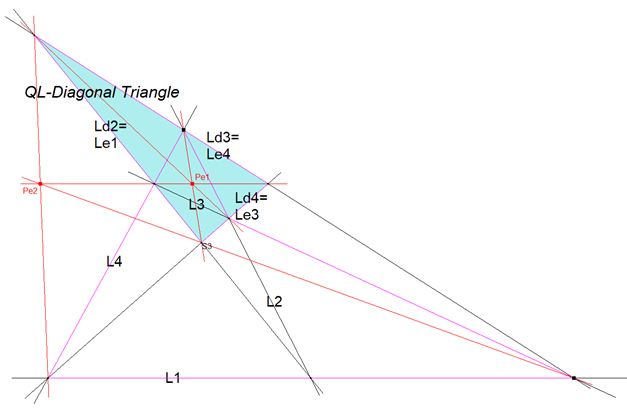
Next, determine for each QG the intersection point (QG-P1) of the opposite QG‑lines, which will be a vertex of the QL-DT, and denote its opposite QL-DT sideline Lei (where i is the index of the line opposite L2 in the QG):
- L2.L4.L1.L3 yields Le1 (index taken from the QG‑line opposite L2)
- L2.L3.L4.L1 yields Le4
- L2.L4.L3.L1 yields Le3
Now the triangles Le1.Le3.Le4 and L1.L3.L4 are in perspective with perspector Pe2.
Reorder the 3 Component Quadrigons so that they all begin with L3.
We then obtain: L3.L2.L4.L1, L3.L4.L1.L2, and L3.L1.L2.L4.
Next, determine for each QG the intersection point (QG-P1) of the opposite QG‑lines, which will be a vertex of the QL-DT, and denote its opposite QL-DT sideline Lfi (where i is the index of the line opposite L3 in the QG):
- L3.L2.L4.L1 yields Lf4 (index taken from the QG‑line opposite L3)
- L3.L4.L1.L2 yields Lf1
- L3.L1.L2.L4 yields Lf2
Now the triangles Lf1.Lf2.Lf4 and L1.L2.L4 are in perspective with perspector Pe3.
Reorder the 3 Component Quadrigons so that they all begin with L4.
We then obtain: L4.L1.L3.L2, L4.L1.L2.L3, and L4.L3.L1.L2.
Next, determine for each QG the intersection point (QG-P1) of the opposite QG‑lines, which will be a vertex of the QL-DT, and denote its opposite QL-DT sideline Lgi (where i is the index of the line opposite L4 in the QG):
- L4.L1.L3.L2 yields Lg3 (index taken from the QG‑line opposite L4)
- L4.L1.L2.L3 yields Lg2
- L4.L3.L1.L2 yields Lg1
Now the triangles Lg1.Lg2.Lg3 and L1.L2.L3 are in perspective with perspector Pe4.
Other relationships of the QL-Component Triangles
The order of the reference lines of the QL‑Component Triangles is also important when comparing them with other triangles constructed from QL‑quadrigons. These triangles are also called QL-Triple Triangles (see QL-Tr-1).
The types of relations between a QL-Triple Triangle and simultaneously the 4 QL-Component Triangles are called:
- Quadri-Perspective relation
- Quadri-Orthologic relation
- Quadri-Cyclologic relation
- Quadri-Eulerologic relation
These relations correspond to the analogous relationships for a Quadrangle, as described in QA-Tr-1. The corresponding QL-examples have not yet been elaborated.
Estimated human page views: 1561